
Materials
Materials
Material · Finish · Application
Glass
Best for decorative plaques, awards, branded panels and premium printed or engraved applications.
Request a Quote Compare all materials
Generated illustrative image; not a GT Laser workshop photograph.
Edited composition based on GT Laser gasket photographs.
What is it?
Glass is a rigid transparent material used for premium plaques, awards and decorative signage. Its composition, coatings and heat treatment influence processing; it is not interchangeable with clear acrylic.
Appearance & characteristics
A hard, smooth face and clear edges create a distinctive premium appearance. Glass is comparatively heavy and can chip or break. Edge condition, impact risk and the support arrangement are important parts of the product specification.
Why choose it?
- Premium clear appearance
- Suitable for decorative surface treatments
- Can support colour and white-underbase print routes where tested
Typical applications
- Plaques and awards
- Decorative signs
- Printed panels
- Branded display pieces
Manufacturing processes
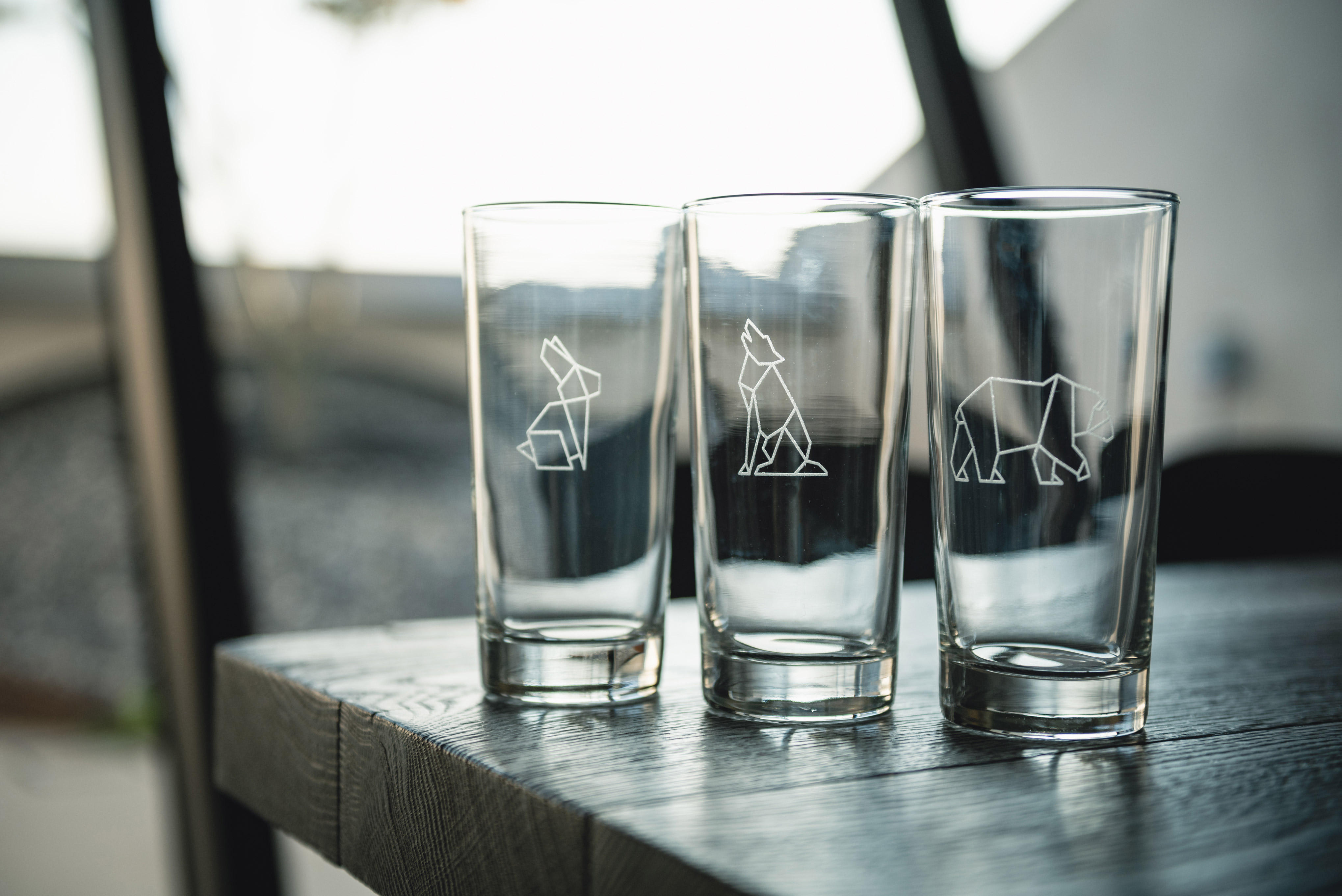
Surface laser engraving can create a frosted mark on suitable glass. Results depend on formulation and surface condition, so a representative test may be needed.
UV printing adds colour to suitable flat glass after adhesion assessment. White ink can provide an opaque foundation or selected white detail; transparent and reverse-view designs need an agreed layer order.
GT Laser works with suitable finished glass pieces for surface decoration. Laser cutting of glass is not offered.
Thicknesses & formats
Provide finished dimensions, thickness, glass type, coatings and edge condition. Confirm the available flat print area and any handling or fixture restrictions before supplying high-value pieces.
Fixing options
- Purpose-designed stands or frames
- Suitable mechanical or adhesive systems after review
- No fixing
Confirm the mounting surface, hole positions, load and removal requirements before choosing the fixing.
Indoor & outdoor considerations
Suitability depends on glass formulation, coating, surface treatment, impact risk and installation.
Tell us about moisture, sunlight, handling and cleaning. Suitability is assessed for the product and installation, without a universal lifetime claim.
Design considerations
- Define the viewing side, transparency and white-underbase areas before artwork is prepared.
- Review the installed background for colour and QR readability.
- Specify existing holes or purpose-designed supports; fixing changes need a suitable glass component, not an assumption that holes can be added.
- Cleaning products, coatings and handling can affect print adhesion. A sample or spare may be requested.
Practical guidance
Glass: practical questions
A test may be recommended for unfamiliar, coated, customer-supplied or high-value items, when exact appearance matters, or when UV-print adhesion is uncertain. A spare or sample piece may be required.
Colour often needs a white underbase on dark, coloured or transparent items. Production-ready vectors may use the spot colour RDG_WHITE, or you can add an unambiguous note such as “WHITE UNDERBASE REQUIRED HERE”.
State “PRINT VIEWED THROUGH THE MATERIAL” and identify both the viewing side and print side. The artwork orientation and colour/white layer order differ from front-surface printing and should be confirmed before production.
Potentially, after the material, composition, geometry, finish and process have been reviewed. Unknown plastics or composites should not be sent for laser processing without a specification or supplier datasheet. A sample, test piece or spare may be requested.
Potentially. A representative sample, exact prototype or short test batch may be recommended depending on the material, process, risk and production quantity.
Discuss Your Requirement
Send the application, dimensions, quantity, material preference and any drawing, artwork or data. We will review the suitable production route.