

Materials
Materials
Oak · Walnut · Alder
Wood
Best for natural, premium and individually distinctive products.
Request a Quote Compare all materials
Generated illustrative image; not a GT Laser workshop photograph.
Generated illustrative image; not a GT Laser workshop photograph.
What is it?
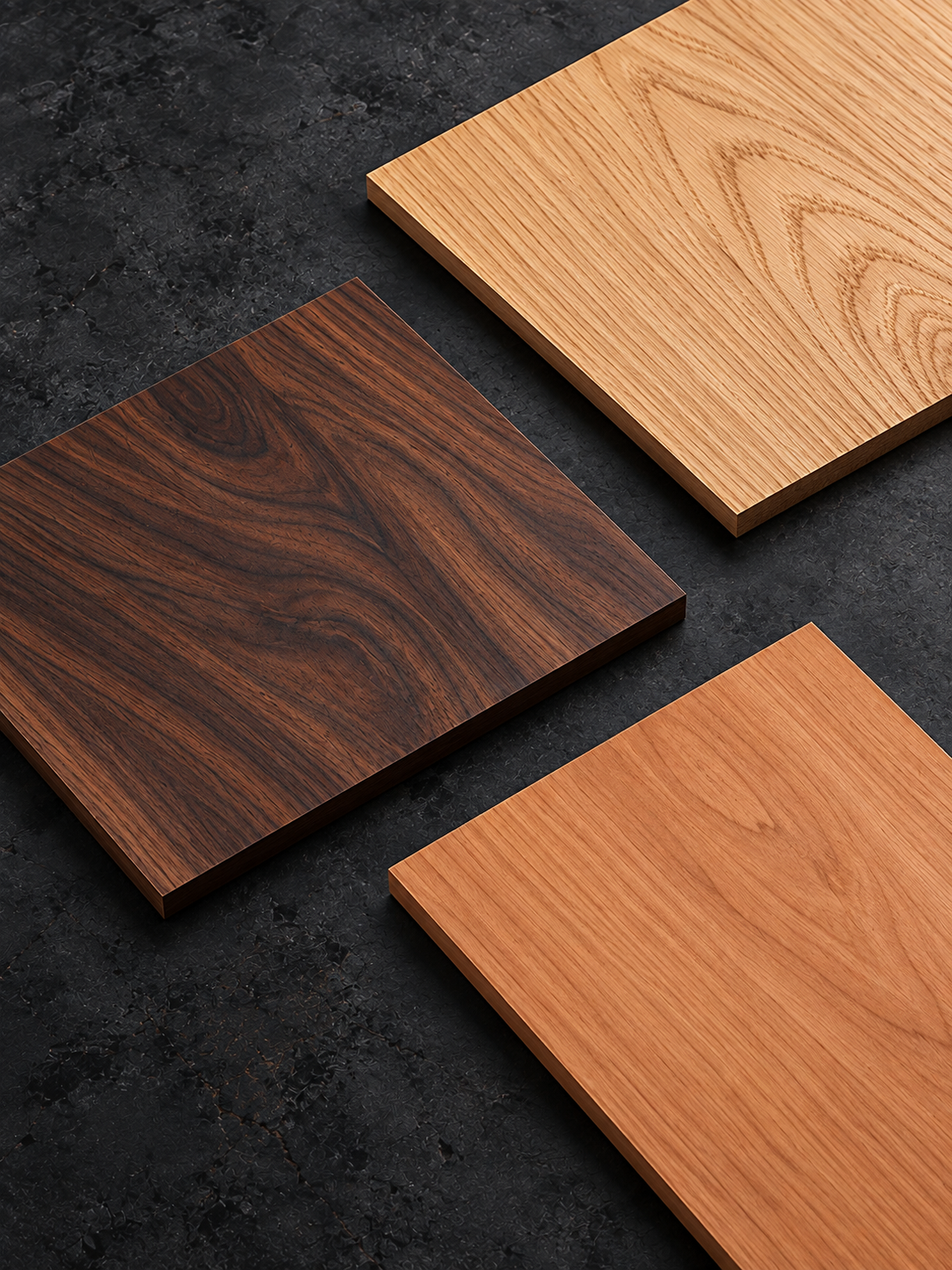
Solid wood is natural timber, with grain and colour that remain visible in the finished product. Oak offers a distinctive grain for signs and custom products. Other species are reviewed individually for the requirement.
Appearance & characteristics
Grain, pores, density and colour vary within and between boards. Wood can move with moisture, and its weight and rigidity depend on the species and dimensions. These characteristics give desk signs, bases, plaques and information boards individual character.
Why choose it?
- Natural premium appearance
- Every piece has individual character
- Suitable for engraved, cut or printed design routes where approved
Typical applications
- Desk signs and name plates
- Information boards and plaques
- Branded signs and product bases
- Custom decorative components
Manufacturing processes
CO₂ engraving darkens or removes the surface to create lettering and graphics. Grain and density change the engraving tone, so natural wood does not reproduce like a uniform plastic.
Profile cutting can be considered for suitable species, thicknesses and geometry. Edge darkening and small-feature strength form part of the review.
UV printing adds colour to suitable flat, prepared surfaces. Oils, sealers and other finishes affect adhesion and colour appearance; the finishing sequence must be agreed.
Thicknesses & formats
State the species, thickness, finished dimensions, grain direction and finish, or send a representative sample. Availability and suitability are confirmed for each requirement; no universal board size or cutting thickness is listed.
Fixing options
- Holes or mechanical fixing
- Suitable adhesive systems
- Freestanding or no fixing
Confirm the mounting surface, hole positions, load and removal requirements before choosing the fixing.
Indoor & outdoor considerations
Outdoor use depends on species, finish, moisture exposure, movement and maintenance; it is not assumed.
Tell us about moisture, sunlight, handling and cleaning. Suitability is assessed for the product and installation, without a universal lifetime claim.
Design considerations
- Allow for grain and colour variation rather than specifying every piece to look identical.
- Review fine text and QR contrast on a representative grain and finish.
- State oils, varnishes or treatments before laser processing or printing.
- Outdoor use needs a suitable species, finish, installation and maintenance plan; it is not assumed from the word wood.
Practical guidance
Wood: practical questions
Suitable wood can be engraved and, depending on species and geometry, cut or UV printed. Natural colour, grain, resin and engraving tone vary from piece to piece; that variation is part of the material.
Potentially, after the material, composition, geometry, finish and process have been reviewed. Unknown plastics or composites should not be sent for laser processing without a specification or supplier datasheet. A sample, test piece or spare may be requested.
A test may be recommended for unfamiliar, coated, customer-supplied or high-value items, when exact appearance matters, or when UV-print adhesion is uncertain. A spare or sample piece may be required.
Depending on the product, options may include no fixing, self-adhesive backing, drilled holes, stand-off holes or another mechanical arrangement. The material, environment and mounting surface determine suitability.
Potentially. A representative sample, exact prototype or short test batch may be recommended depending on the material, process, risk and production quantity.
Discuss Your Requirement
Send the application, dimensions, quantity, material preference and any drawing, artwork or data. We will review the suitable production route.